

| Name: | DATA CENTER |
|---|---|
| HEX Type:: | brazed plate heat exchange |
| Plate Material:: | 304, 316L |
| Plate Thickness:: | 0.4mm |
| Frame Material:: | Stainless steel |
| Design Pressure:: | 0-25bar |
| Inquiry |
Product Description
With the upgrading of AI computing power and the widespread adoption of high-density servers, traditional air-cooling systems can no longer meet the temperature control requirements of modern data centres, and liquid cooling has become the prevailing trend in the industry. As the central hub of a liquid cooling system, the CDU (Coolant Distribution Unit) relies on brazed plate heat exchangers as its key component for heat dissipation; these can be described as the ‘heat exchange heart’ of a data centre’s liquid cooling system.
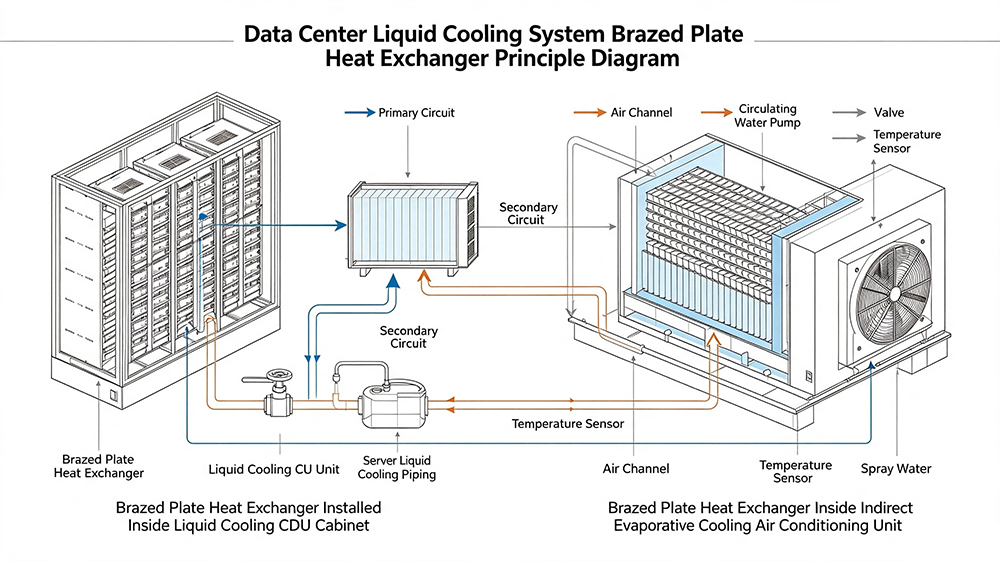
Whilst many people are unfamiliar with this piece of equipment, its operating principle is actually simple and highly efficient. Unlike the inefficient heat exchange mode of traditional tubular heat exchangers, the brazed plate heat exchanger used in the CDU employs a stacked structure of all-stainless-steel corrugated plates. These plates are hermetically sealed and secured as a single unit via a vacuum brazing process, forming independent flow channels for the cold and hot fluids. During operation, the primary water from the data centre’s cooling source and the secondary coolant from the server cooling side flow in counter-current within adjacent channels. Heat transfer is rapidly achieved through the metal plates, ensuring complete isolation of the hot and cold fluids and preventing any mixing during the heat exchange.
The unique herringbone corrugated structure is a key technical highlight, enabling fluids to generate high-intensity turbulence even at low flow rates, thereby completely overcoming the limitations of laminar heat transfer. This design significantly increases the heat transfer contact area, allowing the temperature difference across the heat exchanger to be controlled within 0.5°C–1°C. The heat transfer efficiency far exceeds that of conventional heat exchangers, perfectly meeting the core requirement of precise temperature control for CDUs. Furthermore, the fully brazed sealed structure eliminates the need for rubber gaskets, completely eliminating the risk of leakage and addressing the industry-wide pain points associated with traditional plate heat exchangers, such as ageing and fluid leakage.
Within the entire liquid-cooling system, the brazed plate heat exchanger used in the CDU plays a critical role in isolating and transferring heat. It not only rapidly dissipates the vast amounts of heat generated by server operations but also prevents impurities and scale from the data centre’s chilled water supply from entering the precision IT cooling circuit, thereby protecting core equipment such as servers and chips from corrosion and contamination. Its stable and highly efficient heat exchange performance significantly enhances the precision of temperature control in data centres, providing a solid guarantee for the continuous and stable operation of high-density computing equipment. It is also the preferred choice for liquid cooling retrofits in both small-to-medium and large-scale data centres today.